
If you’re trying to build a sports car for £20,000, starting with a Jaguar might seem an odd way to save money.
But we’re not buying a new Jaguar.
We’re buying the extraordinary amount of engineering contained in a used one.
The Jaguar XE gives us a longitudinal engine and gearbox, rear-wheel drive, independent suspension, modern brakes, steering, differential, hubs and uprights — all engineered, developed and manufactured in quantities we could never hope to reproduce economically.
And used Jaguar XEs are not particularly expensive cars.
That makes the XE interesting.
But as we’ve looked more closely at the car, it has become apparent that the real opportunity may be considerably bigger than simply finding a convenient source of components.
The Jaguar XE isn’t just a parts donor. It could be an engineering donor.
We’re not looking for parts. We’re looking for engineering.
The obvious way to use a donor car is to take the bits we want.
Engine. Gearbox. Differential. Hubs. Uprights. Brakes.
Then design a new car around them.
But every time we discard another part of the donor, we also discard some of the engineering that went into making those components work together.
So we’re asking a different question:
How much of the Jaguar Engineering can we keep?
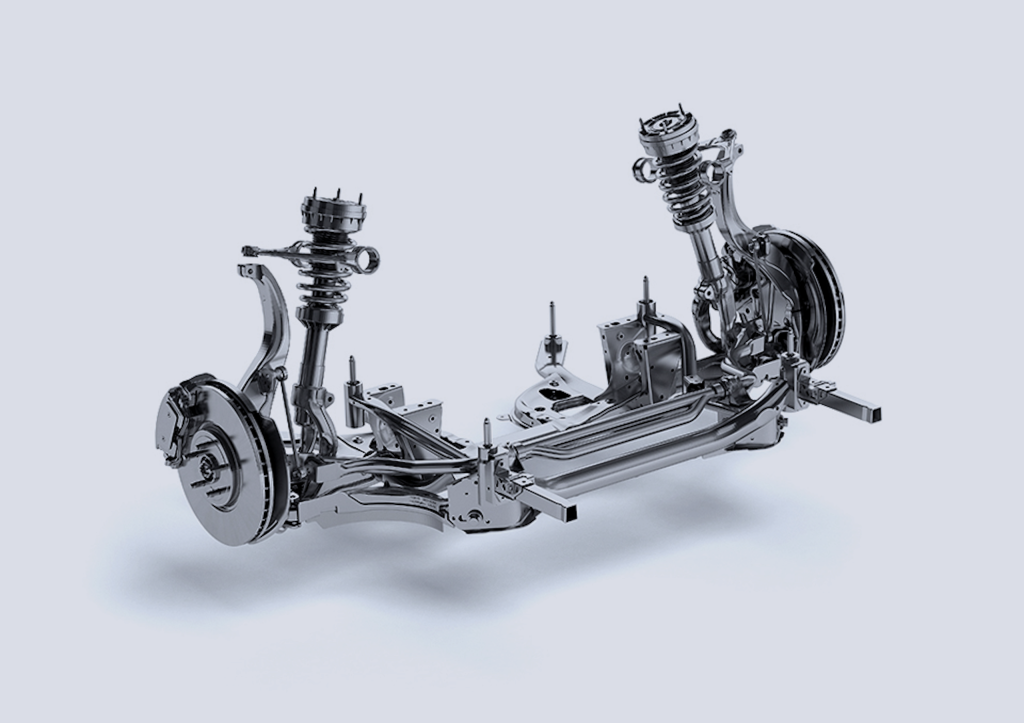
The XE uses double-wishbone front suspension and Jaguar’s Integral Link rear suspension. Aluminium is already extensively used in the suspension components to reduce unsprung mass.
The steering, brakes, suspension and driveline were all developed as parts of the same vehicle.
Perhaps we don’t need to separate them.
For the £20,000 GT-100, the current proposal is therefore to investigate using the complete Jaguar front and rear suspension assemblies, including the production subframes.
That preserves something much more valuable than a collection of Jaguar components.
It preserves their relationship to one another.
STATUS — PROPOSED
The XE isn’t too wide. It’s too long.
This was something we initially got wrong.
The original Austin-Healey 100 had a wheelbase of only 2286 mm. Starting with those proportions made the Jaguar XE suspension appear much too wide for GT-100.
But GT-100 isn’t a 1950s sports car.
Look at contemporary sports cars and a track of around 1600 mm isn’t unusual at all. Jaguar’s own F-Type, along with cars such as the Porsche Cayman, Lotus Emira and BMW Z4, all occupy broadly similar territory.
The XE’s width isn’t particularly strange.
Its 2835 mm wheelbase is.
That’s because the XE has to accommodate four doors, rear seats and all the other things expected of a compact executive saloon.
GT-100 doesn’t.
So rather than narrowing the Jaguar suspension, shortening wishbones and immediately changing the geometry Jaguar designed, we’re going to investigate something much simpler.
Keep the XE track. Shorten the wheelbase.
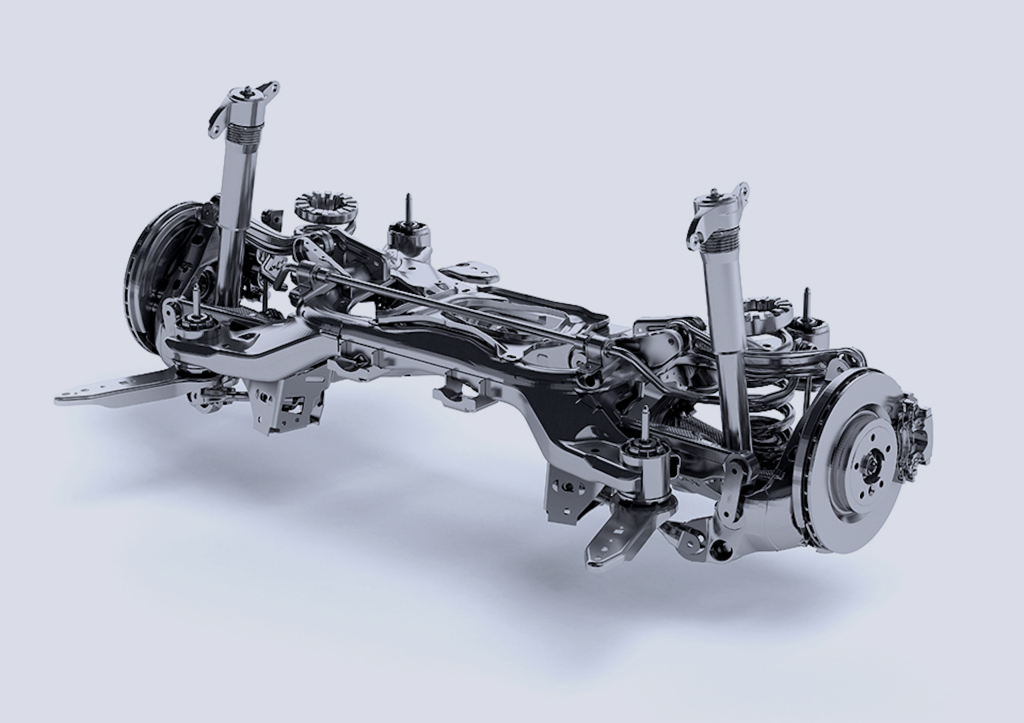
Our present working territory is approximately 2500 mm, although that number remains open until we’ve packaged the powertrain, occupants and suspension properly.
At around that wheelbase, the relationship between track and wheelbase falls squarely into modern two-seat sports-car territory.
And there is another benefit.
GT-100 gains a properly usable cockpit.
We aren’t trying to squeeze a modern powertrain, adequate crash structure and a six-foot driver into dimensions established more than seventy years ago.
[Suspension →]
The Healey gives GT-100 its inspiration. It doesn’t have to give us its dimensions.
Change as little as possible.
This could have a profound effect on the £20,000 car.
If we retain the Jaguar track and suspension hard points, it may be possible to use the complete production front and rear subframes.
And attached to those subframes is an extraordinary amount of useful car.
Potentially:
- suspension arms and uprights
- hubs and bearings
- springs and dampers
- anti-roll bars
- steering rack
- brakes
- rear differential and driveshafts
The powertrain then sits between them using as much of the Jaguar installation as proves practical.
Instead of designing a new suspension system around Jaguar components, we’ve inherited a suspension system.
Shortening the wheelbase will obviously require changes elsewhere. The propshaft is one obvious example, and packaging the exhaust, cooling system, fuel tank and electrical systems will all require work.
But that’s very different from designing an entire vehicle dynamics package from scratch.
There’s an important caveat:
This is the theory. Development now has to find out how much of it survives contact with a real Jaguar XE.
One donor family. A lot of possibilities.
The XE wasn’t built around one engine or even one driveline configuration.
Across the XE family Jaguar used four-cylinder petrol and diesel engines, the supercharged V6 and, at the extreme end of the family, the supercharged V8 in Project 8.
There were manual and automatic transmissions, rear-wheel-drive and all-wheel-drive cars, together with different brakes, differentials and performance specifications.
Not every combination offered across the XE family will necessarily work in GT-100.
Nor do we need them all to.
The important thing is that those possibilities exist before we design the chassis around one particular donor.
It also means we’re not creating an orphan mechanical package.
Jaguar specialists already offer suspension, brake, engine, transmission and performance solutions for the XE and related Jaguar models.
GT-100 can take advantage of an existing ecosystem rather than requiring every future owner to obtain components unique to GT-100.
Measure Jaguar’s answer before drawing our own.
Eventually we need dimensions.
Lots of them.
But rather than attempting to recreate Jaguar’s suspension geometry from photographs and drawings, there’s a rather more reliable solution.
Buy an XE.
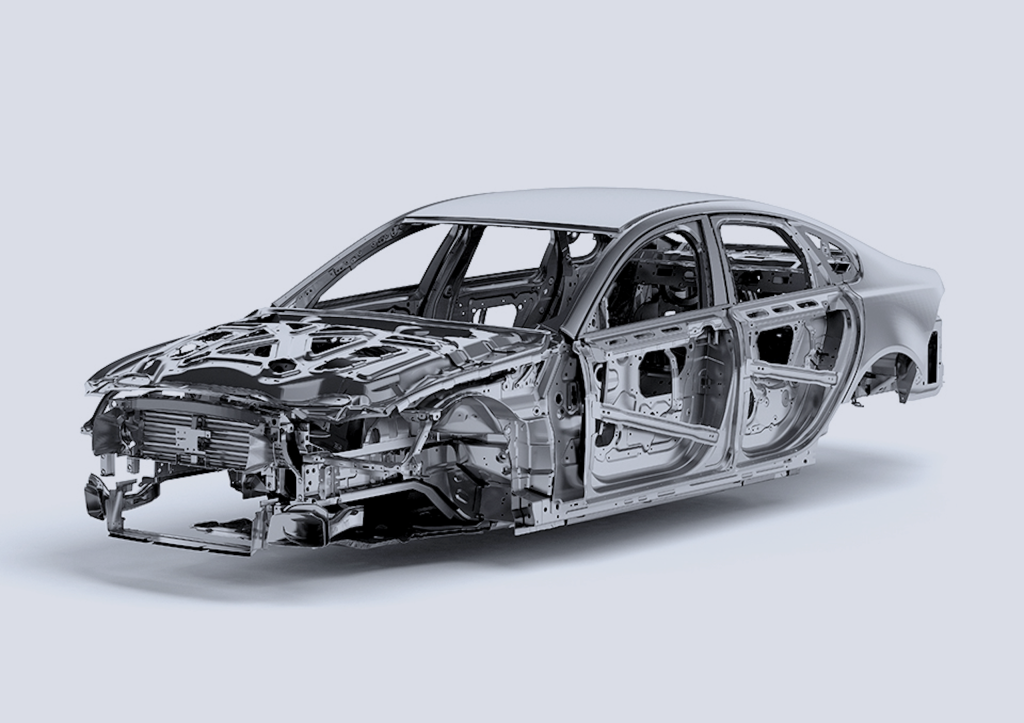
A known-straight donor can be stripped and mounted on a level build table. From there we can establish a centreline and datum plane and physically capture the positions of the front and rear subframes, powertrain and other important structural hard points.
The first GT-100 chassis can then be designed around those known positions — with the rear axle moved forward to establish the shorter wheelbase.
Measure Jaguar’s answer before drawing our own.
That donor car effectively becomes the first GT-100 chassis jig.
£20,000 vs £100,000
This is also beginning to give the two versions of GT-100 a much clearer engineering relationship.
They don’t need to be fundamentally different cars.
The £20,000 GT-100
Use the production Jaguar subframes.
They’re steel. They’re mass-produced. They’re probably heavier than anything we’d design with an unrestricted budget.
But they’re inexpensive, readily available and they already put the suspension components where Jaguar intended them to be.
For a £20,000 sports car, that’s an extremely compelling argument.
£20k — use Jaguar’s answer.
The £100,000 GT-100
The more expensive car gives us the opportunity to ask what compromises remain.
Interestingly, replacing all those Jaguar suspension components may not be the answer.
Jaguar has already used aluminium extensively in the suspension, so there may be surprisingly little worthwhile mass to remove from some of the moving components.
What the standard XE doesn’t give us is the degree of adjustment we’d like in a development sports car.
So one proposal for the £100,000 GT-100 is a purpose-designed lightweight front and rear subframe system.
The standard Jaguar suspension geometry becomes our Position Zero.
From there, adjustable suspension pickup points could allow us to investigate geometry changes deliberately and repeatably rather than altering several parameters accidentally by changing wishbones or lowering the springs.
The new subframes could also allow the GT-100 chassis to sit approximately 50 mm lower relative to the wheel centres, without achieving that reduction simply by lowering the suspension out of its intended operating position.
We retain the good Jaguar components.
We change the structure around them.
£100k — make Jaguar’s answer adjustable.
STATUS — CONCEPT
So, why Jaguar?
Because Jaguar gives us much more than a cheap engine and gearbox.
It gives us a family of developed mechanical systems — suspension, steering, brakes and driveline — designed to work together.
For the £20,000 GT-100, using as much of that engineering as possible may be what makes the project economically achievable.
For the £100,000 GT-100, it gives us a thoroughly developed baseline against which every expensive alternative can be measured.
If the production component works, use it.
If it doesn’t, understand why before designing its replacement.
Use production engineering where it’s good enough.
Spend our engineering effort where it isn’t.