The objective
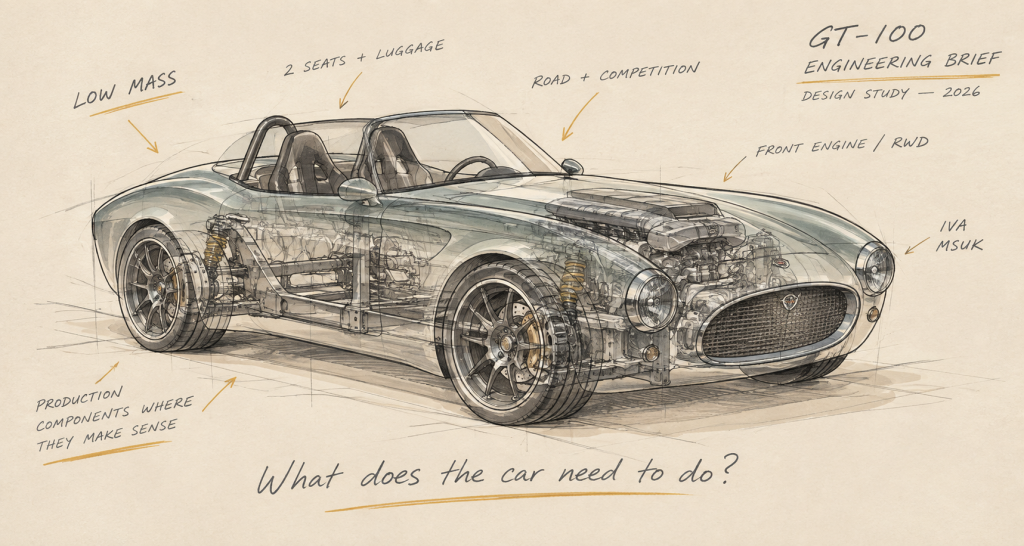
GT-100 is to be a lightweight two-seat grand touring sports car designed from the outset for both road use and Motorsport UK sprint, track days and hillclimb competition.
It should be comfortable, usable and maintainable enough to undertake long road journeys, while retaining the simplicity, balance and driver involvement expected of a traditional sports car.
The car must not become a track car compromised for the road, nor a road car subsequently modified for competition.
The brief is to make one car capable of both.
Design priorities
Low mass
Weight is to be treated as a primary design constraint rather than something corrected later with more power.
Good suspension geometry
Roll centre, camber control, bump steer, caster, kingpin geometry and track changes are to be designed deliberately rather than inherited accidentally from donor components.
Road usability
Reasonable ground clearance, compliant suspension, effective weather protection, usable doors, sensible seating position, luggage capacity and manageable cabin access all matter.
Competition capability
The chassis, suspension, brakes and safety structure should allow the car to be configured for Motorsport UK sprint and hillclimb use without fundamental redesign.
Serviceability
Consumable and mechanical parts should, wherever sensible, come from established production vehicles or recognised motorsport suppliers.
Repairability
The car should be understandable and maintainable by a competent owner without reliance on proprietary dealer equipment wherever this can reasonably be avoided.
Longevity
Avoid components that are already obsolete, unusually difficult to obtain or likely to leave future owners dependent on a single supplier.
Architecture
Front-engine, rear-wheel-drive two-seat sports car.
Longitudinal engine and transmission.
Independent suspension at all four corners.
Purpose-designed chassis.
Production-derived driveline and selected suspension/braking components where they offer a genuine engineering or cost advantage.
The first development path will be based around the Jaguar XE X760 as the principal donor architecture.
Two expressions of the same car
The GT-100 architecture should accommodate two very different approaches.
The accessible GT-100
A car making extensive use of production Jaguar components, with the objective of allowing a competent home builder to complete the car for approximately £20,000.
Cost reduction is to come from intelligent use of mass-produced components, not from poor engineering.
The ultimate GT-100
The same basic architecture developed with lightweight, adjustable and higher-performance components where appropriate.
This version is not constrained by the £20,000 target and may realistically reach £100,000 in completed form.
The purpose of this version is to establish how far the GT-100 architecture can be developed without changing its fundamental character.
[Compare the two rolling chassis →] page to come.
Powertrain
The initial donor strategy is based around Jaguar XE longitudinal drivetrains.
The 2.0-litre four-cylinder engine provides the baseline for the affordable car.
Higher-output Jaguar engines and alternative transmissions may be accommodated where packaging, cooling, weight distribution and regulatory requirements allow.
Manual and automatic transmissions should both remain viable.
The chassis should not unnecessarily prevent future powertrain development.
Where possible, packaging decisions made now should leave room for later alternatives.
Chassis
The chassis should be:
- light
- torsionally stiff
- straightforward to manufacture
- repairable
- adaptable to more than one body style
Suspension loads should enter the structure through clearly defined and adequately triangulated load paths.
The chassis should provide a repeatable body mounting interface so that other body designs can be developed independently of the rolling chassis.
Suspension
Suspension geometry is to be designed specifically for GT-100.
Production uprights, hubs and bearings may be used where suitable, but the geometry of the car must not simply be inherited from the donor.
The suspension must provide:
- predictable camber gain
- controlled bump steer
- appropriate caster and self-centring
- suitable roll-centre behaviour
- adequate wheel travel for road use
- straightforward adjustment for competition
The road car should not require excessively stiff springs to achieve acceptable body control.
The competition version should allow additional adjustment without fundamentally changing the suspension architecture.
[Suspension →]
Steering
Steering must be direct, progressive and communicative without becoming excessively heavy at low speed.
Manual steering remains desirable if acceptable effort can be achieved.
Electric assistance may be used where it improves usability without removing steering feel.
Geometry must be designed around the selected upright and steering-arm configuration rather than adapted afterwards.
Brakes
Production Jaguar braking components provide the baseline.
Brake capacity should be matched to vehicle mass and intended use rather than selected for appearance.
The affordable car should retain readily available production components wherever suitable.
The higher-performance car may use lighter or more capable motorsport systems.
Pedal feel, balance and cooling are to be considered part of the system rather than afterthoughts.
Aerodynamics
The body should retain its period character while benefiting from discreet aerodynamic development.
The objective is not to create visible modern aero appendages for their own sake.
Attention should instead be paid to:
- front underbody airflow
- splitter treatment
- wheel-arch pressure
- cooling-air management
- underfloor flow
- roof and rear-window separation
- rear lift
Any aerodynamic device should justify itself through function.
[Aerodynamics →]
Body and packaging
The first body will draw heavily on the proportions and character of the Austin-Healey 100.
It is not intended to be an exact mechanical recreation of that car.
The body must accommodate:
- sensible cabin access
- comfortable seating
- effective weather protection
- usable luggage space
- road-legal lighting
- adequate cooling
- practical servicing access
The rolling chassis should also be capable of accepting entirely different body designs.
[The body →]
Regulatory requirements
The road-going GT-100 must be designed with IVA compliance in mind from the outset.
Competition requirements should be considered concurrently rather than retrofitted later.
Where IVA and Motorsport UK requirements conflict, the design should seek a solution that allows the car to move between road and competition configurations with minimal alteration.
Development status
This document is a brief, not a finished specification.
Each item should eventually be marked as one of:
Defined
The decision has been made and engineered.
Proposed
The current preferred solution.
Target
A measurable objective still to be demonstrated.
Open
Not yet resolved.