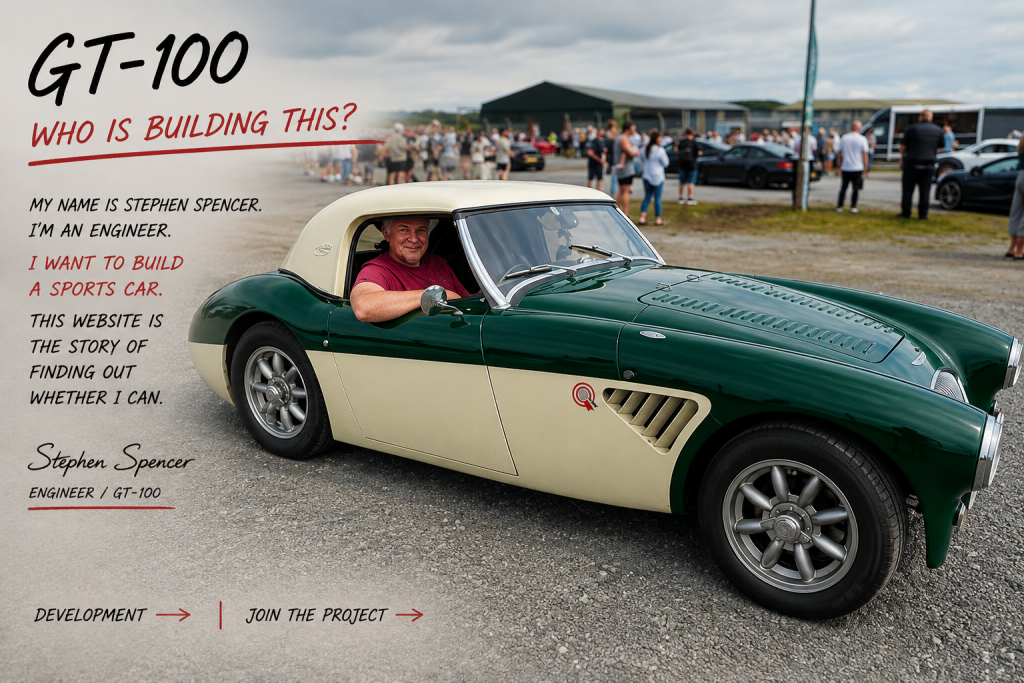
My name is Stephen Spencer. I’m an engineer.
I’ve spent most of my working life designing things, building things and solving engineering problems.
I started as an electro-mechanical engineering apprentice, went on to study electrical and electronic engineering, and spent much of my professional career developing scientific instrumentation — particularly mass spectrometers.
I was a founding member of Kore Technology, designing and manufacturing specialist scientific instruments for researchers around the world.
None of that makes me a car designer.
But it did teach me something rather useful:
how to start with an idea and turn it into something that actually works.
Cars were always the other engineering problem
Cars have occupied the other half of my brain for most of my life.
I’ve owned them, rebuilt them, modified them, competed in them and spent an unreasonable number of hours trying to understand why they behave as they do.
These days much of that happens in my workshop in Wales and on my Steve’s Steel YouTube channel.
I’m interested in cars mechanically rather than simply as objects.
Why did the designer do that?
What happens if we change this?
And, perhaps most importantly:
Do we actually need all this stuff?
Then there was the Haldane
GT-100 hasn’t appeared completely out of nowhere.
In the early 1990s I was involved in the development of the Haldane HD100, a small-volume British sports car inspired by the Austin-Healey 100.
I was entirely responsible for the design, development and standardisation of the car’s electrical systems and wiring loom, turning what had effectively been prototype wiring into a repeatable system suitable for production.
I also contributed to chassis modifications intended to improve the structural stiffness of the car.
And I owned one. Q776 LFL.
More than thirty years later, in 2026, I bought another Haldane.
Driving it again was rather like picking up an engineering conversation we’d left unfinished.
The fundamental idea still works beautifully: small, light, front-engined, rear-wheel drive, simple and two seats.
But almost everything available to the designer has changed.
Modern engines and transmissions. Modern brakes and tyres. CAD. CNC machining. 3D printing. Better materials. Affordable electronics. And an enormous catalogue of highly developed production components.
So I started wondering:
If we began that conversation again today, where would it lead?
That became GT-100.
Two questions
GT-100 is really an engineering experiment built around one chassis and two questions:
Can we build it for £20,000?
How good can we make it for £100,000?
The first forces us to be clever about cost, manufacturing and the use of production components.
The second removes cost as the dominant constraint and lets us find out which expensive solutions genuinely make the car better.
Same basic car. Same objectives.
Two very different approaches to getting there.
I’ve done some of this before. I haven’t done all of it.
I’ve helped develop a low-volume sports car before.
I haven’t designed an entire one.
GT-100 takes me into areas where there are people who know vastly more than I do — aerodynamics, composites, vehicle dynamics, structural analysis, suspension design, manufacturing, IVA and motorsport regulations among them.
That’s one reason this website exists before the car does.
I want those people involved while their knowledge can still change the design.
If I’ve got something wrong, I’d rather hear about it while it’s a pencil line than after we’ve made it from aluminium.
Come join me on the drawing board.
Build it in public
That’s the plan.
Design it.
Calculate it.
Build it.
Test it.
Publish what happens.
Change the things that don’t work.
And keep going until one of these drawings becomes a car sitting outside the workshop.
I don’t know exactly where we’ll end up.
But I know where we’re starting.