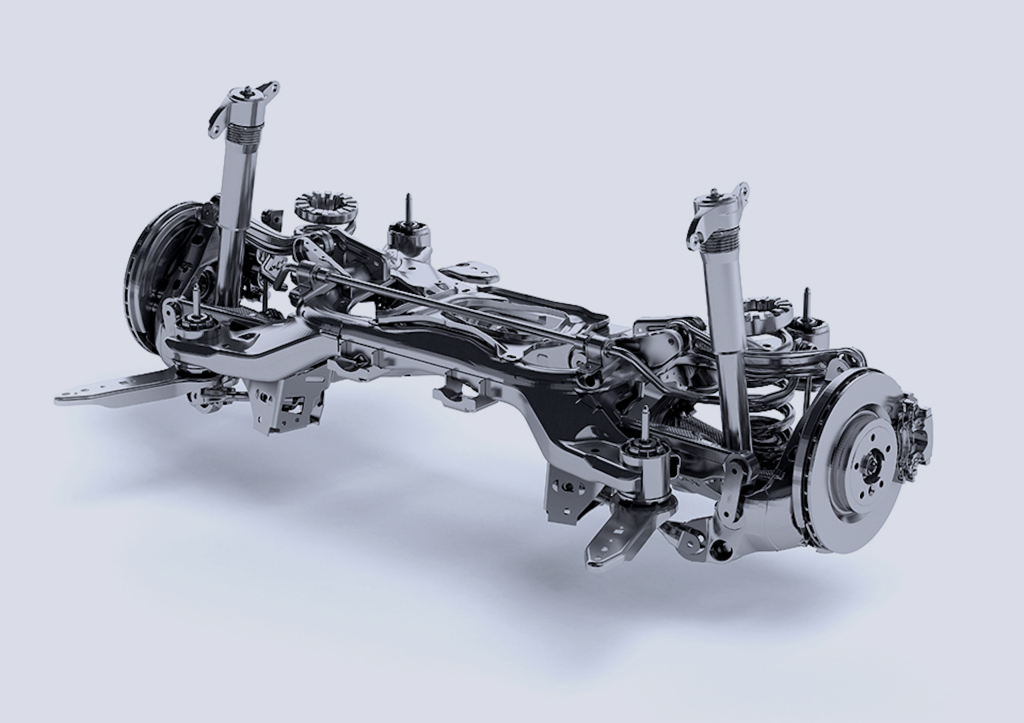
The Jaguar XE gives us a complete suspension system.
That creates an interesting possibility.
Instead of designing GT-100 suspension from scratch, we can begin with a system Jaguar has already engineered, developed and production-tested — and find out how much of it we can use unchanged.
The easiest suspension system to design is the one somebody else has already spent millions developing.
The question is no longer:
How should we design the GT-100 suspension?
It is:
What happens if we simply use the Jaguar XE suspension as Jaguar designed it?
Start with the Jaguar baseline
The current proposal for the £20,000 GT-100 is to retain the XE’s front and rear suspension assemblies at approximately their original track width.
That means preserving the relationships between:
- suspension pickup points
- wishbones and links
- uprights
- steering rack
- anti-roll bars
- hubs and brakes
- differential and driveshafts
In other words, we begin with Jaguar geometry, not with a blank sheet of paper.
The XE uses double-wishbone front suspension and Jaguar’s Integral Link rear suspension, with extensive use of aluminium in the moving components.
For a production saloon, Jaguar has already done a great deal of the work we would otherwise have to reproduce ourselves.
So before changing anything, we need to understand exactly what they gave us.
STATUS — BASELINE TO BE MEASURED
Shorter car. Same suspension.
The XE has a wheelbase of 2835 mm.
GT-100 does not need four doors or rear seats, so the current proposal is to shorten that substantially — probably into the region of 2600 mm, although the final number remains open.
Importantly, shortening the wheelbase does not automatically require us to change the front or rear suspension geometry.
The two axle modules can remain essentially where Jaguar intended them to be relative to their respective wheel centres.
We simply move them closer together.
That gives us a useful starting hypothesis:
Retain the XE suspension geometry. Change the distance between the axles.
If that works, the £20,000 GT-100 inherits a complete modern suspension system without the cost or risk of developing one from scratch.
But the GT-100 will not be an XE
This is where things become interesting.
Even if we retain the suspension geometry, the car around it will be very different.
GT-100 should be:
- considerably lighter
- lower
- shorter
- two-seat rather than four-seat
- likely to have a different centre-of-gravity height
- likely to have a different front/rear weight distribution
That means the Jaguar suspension will be operating in a very different vehicle.
Some of that may be beneficial.
Some of it may expose compromises we need to address.
And some of it may make surprisingly little difference.
We do not yet know.
Ride height
This may be the first important problem.
It would be very easy to make GT-100 look lower simply by fitting shorter springs or winding down the coilovers.
But lowering the chassis relative to the wheel centres changes the suspension’s static position.
That can alter:
- wishbone and link angles
- roll-centre height
- camber gain
- bump steer
- suspension travel
- driveshaft angles
- anti-dive and anti-squat characteristics
So the target cannot simply be:
Make it 50 mm lower.
The real question is:
How low can the £20,000 car go before the Jaguar geometry stops behaving the way we want?
That needs to be modelled and then measured.
STATUS — OPEN
Geometry before appearance
This is one of the places where GT-100 has to resist the temptation to design the car visually first.
If the suspension wants a particular relationship between the wheel centre and the chassis, the body should be designed around that relationship.
Not the other way round.
That does not mean the car has to sit at XE ride height.
It means that any change should be made deliberately, with an understanding of what else changes with it.
The engineering gets to have a vote.
What do we actually need to measure?
The definitive data should eventually come from a real, known-straight XE.
Once the donor is stripped and placed on a level table, we can establish the original geometry directly rather than relying entirely on drawings or assumptions.
The measurements we want include:
Front
- upper and lower wishbone pickup positions
- upright ball-joint positions
- steering rack position
- steering-arm position
- static caster
- static camber
- toe
- kingpin / steering axis
- wheel centre
- damper and spring mounting points
- anti-roll-bar geometry
- suspension travel
Rear
- all Integral Link pickup points
- hub centre
- toe-control geometry
- camber-control geometry
- differential location
- driveshaft position
- spring and damper points
- anti-roll-bar geometry
- suspension travel
From that we can build a proper suspension model.
Target → model → measure → compare.
What happens when we remove several hundred kilograms?
This is probably more important than it first appears.
The production XE suspension was developed around the mass, tyre loads and weight distribution of an executive saloon.
GT-100 will be much lighter.
That means we will certainly need different spring and damper rates.
Anti-roll-bar stiffness may also need to change.
But that does not automatically mean the basic geometry is wrong.
In fact, the lighter car may place substantially lower loads on components already designed for something much heavier.
That is potentially one of the great advantages of the donor approach.
Use Jaguar’s geometry first. Tune the rates to suit GT-100.
£20,000 — use the Jaguar geometry
The working philosophy for the £20,000 car is therefore deliberately conservative.
Retain:
- production XE subframes
- production suspension pickup points
- production arms and uprights
- production steering geometry
- production hubs and brakes
Then tune the things a vehicle manufacturer would normally tune for a different derivative:
- springs
- dampers
- anti-roll bars
- alignment
- tyres
If that gives us the behaviour we want, there is no engineering prize for replacing it.
£20k — use Jaguar’s answer.
£100,000 — make the geometry adjustable
The £100,000 car gives us a different opportunity.
Jaguar has already done a good job of reducing unsprung mass with aluminium arms, uprights and other suspension components.
So rather than automatically replacing those parts, the more valuable upgrade may be a purpose-designed GT-100 subframe.
That subframe could retain the Jaguar outboard components while adding adjustment at the inboard pickup points.
Potentially allowing us to alter:
- roll-centre position
- camber curve
- caster
- anti-dive
- anti-squat
- rear toe behaviour
- track
- static geometry
The standard XE positions become our Geometry Zero.
Any changes can then be measured relative to a known baseline.
Lower without compromising the geometry
A GT-100-specific subframe could also solve the ride-height problem properly.
Instead of lowering the suspension relative to the wheel centre, the subframe itself could reposition the chassis mounting plane approximately 50 mm lower while retaining the suspension components in their intended working relationship.
That gives us the possibility of a substantially lower car without simply winding the suspension out of its design position.
This remains conceptual until we have accurate packaging and geometry data.
But it is a much better reason for building a bespoke subframe than simply making one because aluminium looks nicer than pressed steel.
£100k — preserve the good Jaguar components, but give them a more adjustable and better-packaged structure.
STATUS — CONCEPT
What are we trying to achieve?
Not maximum lateral acceleration.
Not a racing car that happens to have number plates.
GT-100 is still intended to be a road car first.
So the suspension targets need to include:
- progressive, predictable breakaway
- good steering feel
- useful suspension travel
- control on poor road surfaces
- stability under braking
- traction on uneven roads
- sensible tyre wear
- adjustability for sprint and hillclimb use
A car that is brilliant on smooth tarmac but unpleasant on a Welsh B-road has missed the point.
Questions still open
This page will remain live because there are several things we genuinely do not know yet.
How low can the production XE geometry operate effectively?
How much does GT-100’s lower mass change the optimum spring, damper and anti-roll-bar rates?
Does the production steering geometry remain suitable?
What happens to bump steer through the intended suspension travel?
Do the rear Integral Link characteristics suit a much lighter, shorter car?
What adjustment would actually be useful on the £100,000 version?
And perhaps the most important question:
Will the £20,000 GT-100 actually need different suspension geometry at all?
We don’t know.
That is what the development programme is there to find out.