One chassis. Many possibilities.
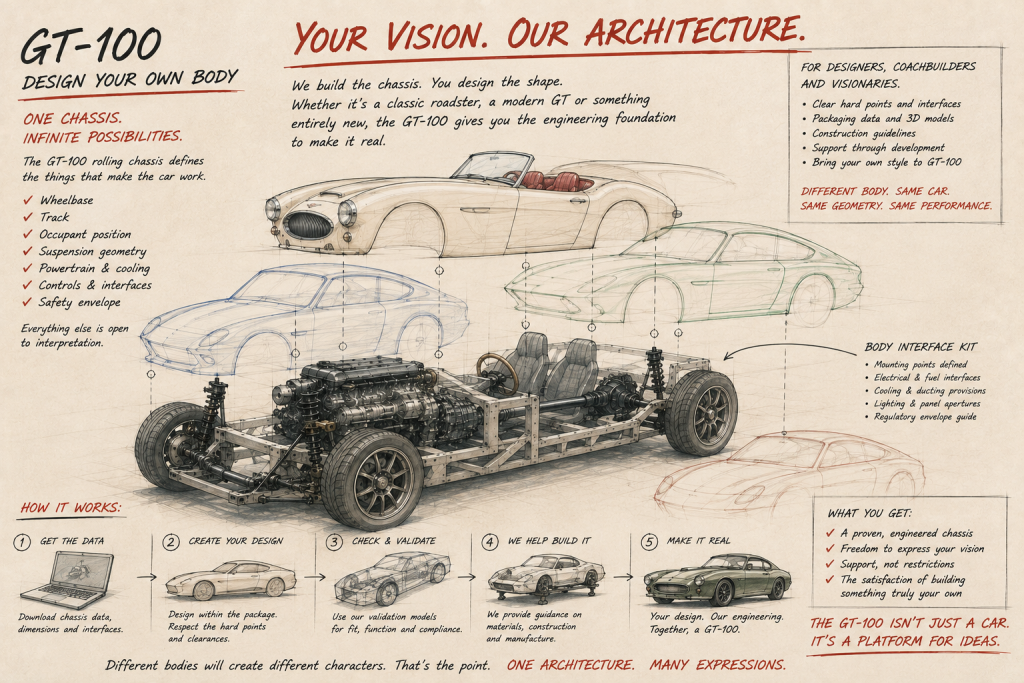
The GT-100 rolling chassis defines the things that make the car work.
Wheelbase.
Track.
Occupant position.
Suspension geometry.
Powertrain.
Steering and controls.
Cooling.
And the principal mechanical hard points.
Everything outside that envelope is open to interpretation.
We will design a GT-100 body. You don’t have to design the same one.
Your vision. Our architecture.
Our first body takes its inspiration from the Austin-Healey 100.
That’s our answer to the problem.
It isn’t necessarily yours.
A properly engineered rolling chassis creates an opportunity for designers, coachbuilders, universities, specialist manufacturers and ambitious individuals to create something entirely different without first having to design an entire car underneath it.
You start with a known mechanical package.
Then you decide what it should look like.
The hard points stay hard
Freedom to design the body doesn’t mean everything can move.
Some things are fundamental to the architecture of the car.
The wheel centres remain where they are.
The suspension needs space to move.
The occupants need somewhere to sit.
The engine, transmission and differential need clearance.
The steering needs to work.
Cooling air needs to enter and leave.
The wheels need clearance throughout suspension travel and steering movement.
And ultimately the finished vehicle needs to satisfy the appropriate regulatory requirements.
Those are constraints.
Everything between them is design.
We’ll provide the envelope
As GT-100 develops, the intention is to make the information required to design a body available alongside the rolling chassis.
That should eventually include:
- principal dimensions and hard points
- wheel and tyre envelopes
- suspension movement
- occupant envelope
- powertrain clearances
- cooling requirements
- body mounting interfaces
- lighting and regulatory considerations
- downloadable CAD reference geometry
The objective is that somebody shouldn’t need to reverse-engineer the GT-100 before they can start designing for it.
[Body Interface / Design Data →]
Start with a pencil
You don’t necessarily need to be an automotive manufacturer.
You don’t even need CAD to start.
Take the side-view package drawing.
Keep the wheel centres where they are.
Keep the occupants inside the envelope.
And draw.
A traditional British roadster.
A closed GT.
Something influenced by the 1960s.
Something completely contemporary.
Something nobody else would have thought of.
Some ideas won’t work.
That’s part of designing things.
But some might.
Then make it work
A beautiful drawing is only the beginning.
Eventually the body has to deal with engineering.
Can you get into it?
Can you see out?
Can the front wheels steer?
Can the suspension move?
Can the engine breathe?
Can hot air escape?
Can you change a headlamp without removing the engine?
Can the body actually be manufactured?
Can it pass IVA?
These questions shouldn’t kill creativity.
They’re what turn styling into design.
We don’t need to manufacture it
This is another important part of the idea.
GT-100 doesn’t necessarily need to manufacture every body that sits on a GT-100 chassis.
A coachbuilder could produce one.
A composite specialist could manufacture a small series.
A university design department could develop one as a project.
A professional designer might simply create the surfaces and work with somebody else to manufacture them.
Or an individual builder might make one car for themselves.
The chassis provides the common engineering foundation.
What happens above it can develop independently.
Different bodies will make different cars
This is perhaps the most interesting consequence.
Change the body and you don’t merely change the appearance.
A lightweight open roadster will have a different character from a closed GT.
Aerodynamics will change.
Weight will change.
Luggage capacity will change.
Weather protection will change.
The experience of sitting inside it will change.
Yet underneath, the suspension geometry, drivetrain and fundamental engineering can remain familiar.
Different body. Same car underneath. Different experience.
We’d like to see what you would do
Eventually, we’d like to publish the GT-100 design envelope and invite people to use it.
Not just established automotive designers.
Students.
Industrial designers.
Coachbuilders.
CAD enthusiasts.
People building cars in sheds.
And people who simply have an idea they’ve always wanted to draw.
Some of those designs might remain drawings.
Some might become renders.
And perhaps one of them eventually becomes another GT-100.
Because if we’ve designed the architecture properly, there shouldn’t only be our GT-100.
There should be yours too.
One architecture. Many expressions.
That’s the larger idea behind the rolling chassis.
We’re not trying to dictate what every GT-100 must look like.
We’re trying to engineer the difficult bit underneath well enough that other people can answer that question for themselves.
[The Rolling Chassis →]
[The Body →]
[Get Involved →]