Aerodynamics
A classic shape, with a little help from modern thinking
The original Austin-Healey 100 was designed more than seventy years ago, when aerodynamic development for a road-going sports car was necessarily very different from today.
The basic shape, however, gives us a remarkably good place to start. The Healey is low, narrow and has a beautifully rounded nose with relatively little frontal area. We don’t want to change what makes it recognisably a Healey.
What we can do is pay more attention to what the air does around and underneath it.
For the GT-100 we’re investigating a number of deliberately subtle aerodynamic improvements intended to reduce lift, improve high-speed stability and reduce unnecessary drag — without turning a 1950s sports car into something that looks as though it has escaped from a modern racing paddock.
Front air management
One of the most useful changes may also be one of the least visible.
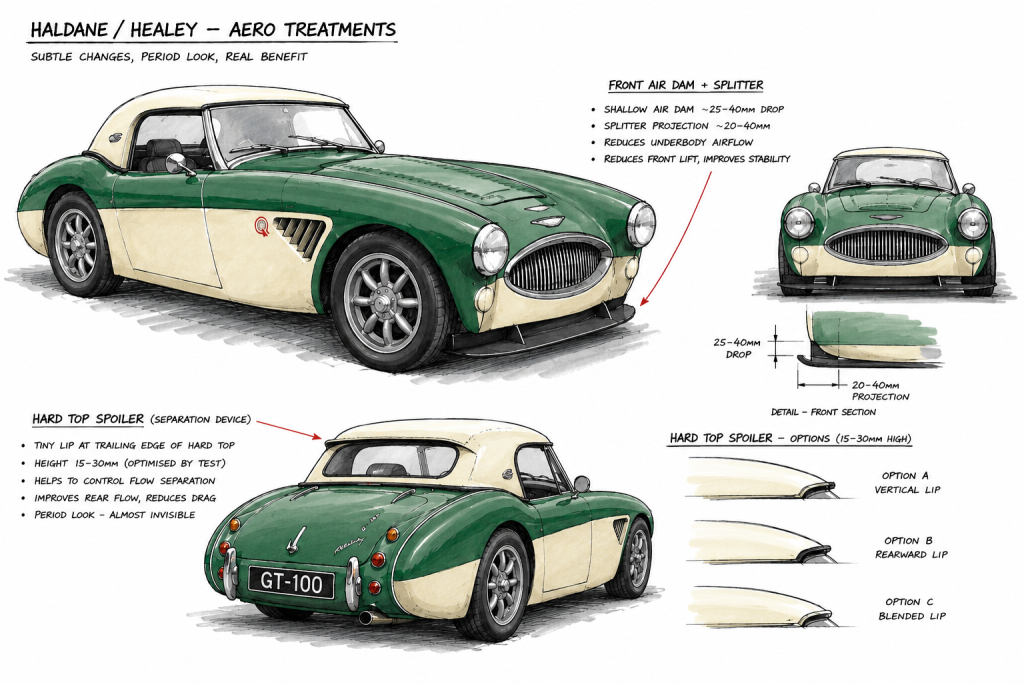
A shallow front air dam and splitter can reduce the amount of high-pressure air passing underneath the car, while encouraging cleaner airflow around the sides. The objective isn’t to generate huge amounts of downforce, but to reduce front-end lift and improve stability as speed increases.
The proposed GT-100 treatment sits beneath the existing body line, so from normal viewing height the character of the original nose remains almost completely unchanged.
Managing the underside
A beautiful body above the chassis doesn’t necessarily mean clean airflow underneath it.
Exposed suspension components, chassis members, the engine, gearbox and exhaust all disturb the airflow and consume energy. The GT-100 gives us an opportunity to consider underbody airflow as part of the car from the outset.
We’re not trying to create an elaborate ground-effect car. Relatively simple panels and careful management of where air enters and leaves the underside could produce worthwhile improvements while retaining accessibility and practicality.
Hardtop airflow
The hardtop creates another interesting opportunity.
Air travelling over the roof eventually has to separate from the car. Rather than allowing that separation to occur unpredictably around the curved rear of the roof, a very small trailing-edge spoiler can provide a controlled separation point.
We’re investigating a subtle lip above the rear window, potentially only a few tens of millimetres in size.
Done correctly, it should be the sort of aerodynamic device that works without announcing its presence.
Develop, test, refine
The GT-100 isn’t being designed entirely on a computer.
Some of these ideas will first be manufactured as prototype components and tested on our existing Haldane HD100 development car. Modern 3D scanning, CAD and additive manufacturing allow us to make different versions quickly, measure the results and refine the design.
That means the Haldane can become a rolling aerodynamic test bed for the GT-100.
And that’s really the philosophy behind the whole project:
Keep the shape. Keep the character. Improve the engineering.