The car underneath the car
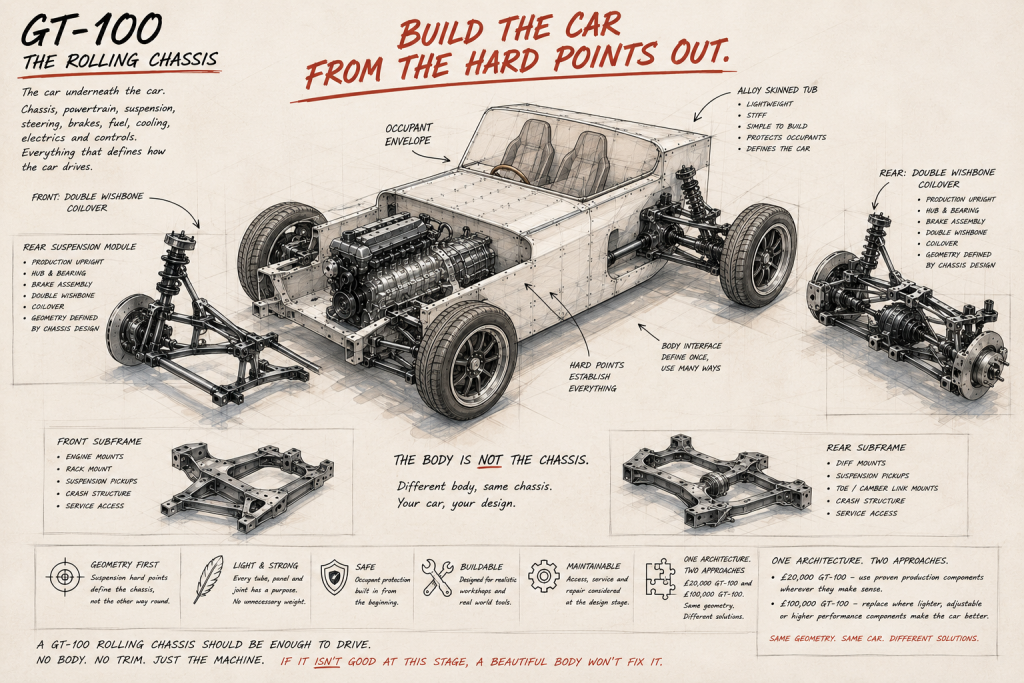
Remove the body from a GT-100 and what remains should still make sense as a complete piece of engineering.
Chassis.
Powertrain.
Suspension.
Steering.
Brakes.
Fuel system.
Cooling.
Electrical architecture.
Seats, pedals and controls.
Everything required to define how the car drives should belong fundamentally to the rolling chassis rather than the shape placed over it.
That distinction is deliberate.
GT-100 is being designed from the chassis out, not the body in.
Start with the hard points
Before drawing a chassis, we need to know where things need to be.
The wheels.
The occupants.
The engine and gearbox.
The differential.
The steering rack.
Suspension pickup points.
Pedals.
Fuel tank.
Radiator.
Luggage.
Those positions establish the packaging envelope around which the structure can then be designed.
The chassis should connect those hard points efficiently rather than forcing the important components to fit around an arbitrary frame.
Suspension geometry comes first
This is particularly important.
It is very easy to design a chassis and then find somewhere convenient to attach the suspension.
GT-100 takes the opposite approach.
The required suspension geometry determines the pickup points.
Then we build the chassis around them.
That allows roll centres, camber gain, caster, bump steer and wheel travel to be considered as part of the fundamental vehicle geometry rather than corrected afterwards.
Production uprights and hubs may provide the wheel-end hardware.
They do not get to dictate the entire suspension.
Structure with a purpose
A lightweight chassis isn’t simply one made from less material.
Every tube, panel, bracket and joint should have a reason to exist.
Suspension loads need clear paths into the structure.
Engine and transmission mounts need to support their loads without unnecessarily reinforcing unrelated parts of the car.
Occupant protection needs to be incorporated into the structure from the beginning.
Body mounting points should be predictable and repeatable.
And stiffness needs to exist where stiffness actually matters.
The objective is not to produce the chassis with the largest possible torsional-stiffness number.
It is to produce a structure sufficiently stiff that the suspension, rather than the chassis, controls the wheels.
Jaguar provides components, not geometry
The Jaguar XE donor gives us access to a valuable collection of production-engineered components.
That does not mean we’re putting a Jaguar XE chassis underneath a different body.
Quite the opposite.
The GT-100 chassis is being designed specifically for a lightweight two-seat sports car.
Jaguar components are used where they solve a problem well.
The GT-100 structure and suspension determine how those components are used.
Package the mass intelligently
A front-engined sports car doesn’t require everything heavy to be hanging ahead of the front axle.
Engine position, transmission position, seating position, fuel location and cooling layout all influence the way the car behaves.
The objective is sensible mass distribution with the heavy components mounted as low and as centrally as practical.
Not because a particular front/rear percentage looks impressive in a specification table.
Because polar moment, centre of gravity and the location of mass all influence how naturally the car responds to the driver.
Buildable matters
GT-100 is not intended to require an automotive production line.
The chassis must therefore be designed around manufacturing processes appropriate to the number of cars we might realistically build.
That means considering:
jigging,
repeatability,
welding access,
component installation,
maintenance access,
and eventually repair.
The cleverest structure in CAD isn’t necessarily the cleverest structure to manufacture.
The body is not the chassis
This is where the idea becomes particularly interesting.
The first GT-100 body may define the appearance of our car.
It doesn’t have to define yours.
If the mechanical package and body interfaces are properly established, the same rolling chassis could carry another interpretation entirely.
Different nose.
Different tail.
Different materials.
Perhaps even an entirely different design language.
The important dimensions remain underneath.
Wheelbase.
Track.
Occupant position.
Mechanical clearances.
Cooling requirements.
Body mounting points.
Regulatory envelope.
Everything outside that becomes an opportunity.
[The Body →]
One architecture, two approaches
The £20,000 and £100,000 cars should share the same fundamental architecture wherever practical.
The affordable chassis makes extensive use of suitable production components.
The unrestricted version allows those components to be replaced where lighter, adjustable or higher-performance alternatives genuinely improve the car.
That gives us something unusually useful:
a direct comparison.
Same geometry.
Same fundamental structure.
Same car.
Different solutions.
A rolling chassis should be enough
Ultimately, there should come a point in the development programme where we can put four wheels on the chassis, install the drivetrain, connect the controls, add a temporary seat…
…and drive it.
No beautifully finished body to disguise anything.
No interior trim.
No paint.
Just the machine underneath.
If it isn’t good at that stage, a beautiful body isn’t going to fix it.