What happens when cost stops being the first constraint?
The £20,000 GT-100 asks how much sports car we can create by making intelligent use of production components.
This one asks a different question.
If we keep the same fundamental car, where can better engineering make it better?
Not more expensive for the sake of being expensive. Not carbon fibre simply because carbon fibre looks exotic. And not a catalogue of fashionable motorsport components.
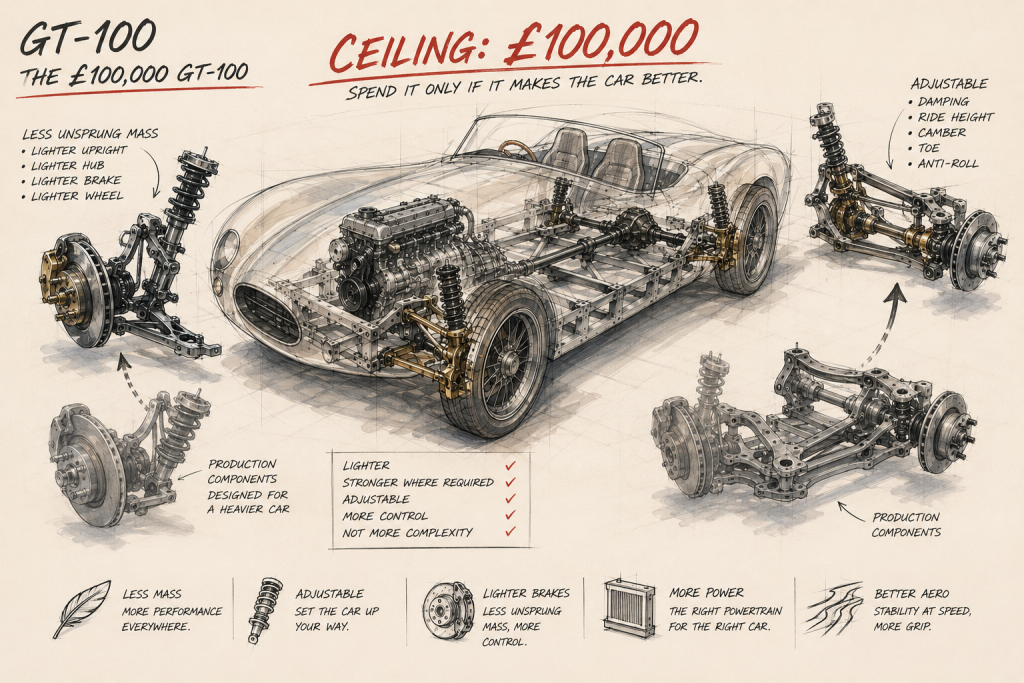
Every additional pound spent should buy something measurable: less mass, better control, greater adjustability, improved performance, increased durability or a better driving experience.
The target is £100,000.
Not because we need to spend it.
Because this time, we’re allowed to.
Start with the same car
The £100,000 GT-100 is not a different model.
It begins with the same fundamental architecture:
Front engine.
Rear-wheel drive.
Two seats.
Independent suspension.
The same basic proportions.
The same relationship between driver, engine and road.
And, wherever possible, the same fundamental chassis architecture.
That matters.
If the expensive car needs an entirely different platform to work, we haven’t demonstrated the potential of GT-100 — we’ve simply designed another car.
Add lightness
The first place to spend money isn’t horsepower.
It’s mass.
The affordable car deliberately uses production components where they make engineering and economic sense. Those components have usually been designed for a much heavier production vehicle and manufactured accordingly.
The unrestricted car gives us the opportunity to revisit them.
Steel suspension component becomes aluminium.
Heavy production seat becomes a lightweight composite shell.
Standard battery becomes lightweight battery technology.
Production exhaust becomes a carefully engineered lightweight system.
Unsprung mass, rotating mass and mass high in the car become particularly interesting targets.
The question isn’t simply:
“Can we make this lighter?”
It is:
“What happens to the car if we do?”
Suspension you can tune
The road car needs good suspension.
The £100,000 car can have adjustable suspension.
Spring rates.
Damping.
Ride height.
Camber.
Caster.
Toe.
Anti-roll stiffness.
Potentially even alternative suspension pickup positions where doing so provides a genuine development advantage.
But adjustment for its own sake is not the objective.
Every adjustment introduces another opportunity to make the car worse.
The baseline geometry must therefore work properly before adjustability is added.
Less unsprung mass
This is one area where spending money can produce benefits almost everywhere.
Lighter uprights, hubs, brakes and wheels allow the suspension to control the tyre more effectively.
They can improve ride quality and grip while reducing the forces the damper has to control.
Lightweight brake discs and wheels also reduce rotating inertia.
This is precisely the sort of improvement the £100,000 GT-100 exists to explore.
Not something that photographs well.
Something you should be able to feel from the driver’s seat.
More performance — where appropriate
More power is obviously available.
The Jaguar donor family provides routes to considerably greater performance than the baseline four-cylinder car.
But engine choice cannot be considered independently.
More power means more cooling.
More torque changes transmission and differential requirements.
A heavier engine affects weight distribution.
Higher speeds affect aerodynamics, braking and safety.
The objective therefore isn’t to install the largest engine that physically fits.
It is to find the powertrain that best suits the car.
[Powertrain →]
Brakes appropriate to the job
The affordable GT-100 may already have more braking capacity than its mass requires simply because its production components were designed for a substantially heavier vehicle.
The expensive car therefore doesn’t automatically need larger brakes.
It may need lighter ones.
Aluminium calipers.
Two-piece discs.
Alternative rotor materials where justified.
Improved cooling.
Adjustable brake balance.
The objective is reduced unsprung and rotating mass while retaining the thermal capacity required for competition.
Bigger isn’t necessarily better.
Materials become a design decision
Once cost is relaxed, material choice becomes much more interesting.
Aluminium.
Composite structures.
Carbon fibre.
Titanium.
High-strength steels.
Additive manufacturing.
All become possibilities.
But the material should follow the requirement.
A beautifully machined titanium bracket doing a job perfectly achievable by a 50-gram steel pressing isn’t necessarily sophisticated engineering.
It may simply be an expensive bracket.
The £100,000 car should still obey the same rule as the £20,000 car:
Spend the money where it matters.
Road car first
This remains important.
The £100,000 GT-100 is not intended to become a racing car with number plates.
It should still be capable of leaving home, travelling several hundred miles, competing at an event and driving home again.
Weather protection still matters.
Luggage still matters.
Ride quality still matters.
Reliability certainly matters.
Removing the cost constraint should make the GT-100 more capable, not less usable.
Two cars. One experiment.
The two versions allow us to perform an interesting engineering experiment.
Build the £20,000 car using intelligent production engineering.
Then progressively replace components where we believe spending more money will make it better.
And measure what happens.
Weight.
Performance.
Ride.
Handling.
Lap or hillclimb times.
Perhaps eventually even subjective driver preference.
Some expensive changes will undoubtedly work.
Others may make remarkably little difference.
And occasionally the cheap production component may turn out to have been the better solution all along.
That is worth discovering too.
£100,000 is a ceiling, not an objective
Just as £20,000 is currently a design target rather than a promised price, £100,000 isn’t a shopping list that needs to be exhausted.
If the best GT-100 we can build costs £72,000, there is no engineering merit in finding another £28,000 to spend on it.
The objective is simply to remove cost as the dominant constraint and discover:
How good can GT-100 actually be?