This is where the drawings become a car
GT-100 doesn’t exist yet.
There are ideas we believe are good.
There are engineering decisions we think will work.
There are targets we want to achieve.
And there will undoubtedly be things we’re completely wrong about.
This page is where we find out.
Rather than presenting GT-100 as a finished design and quietly changing things behind the scenes, we’re going to document the development of the car as it happens.
The successes, the failures and the bits we have to do twice.
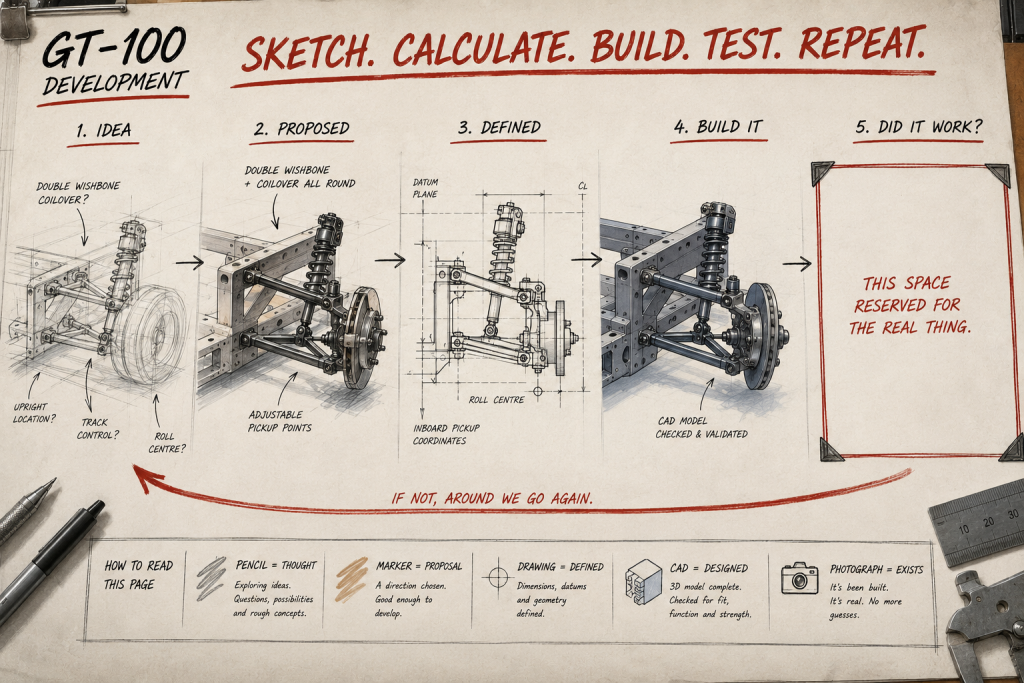
Sketch. Calculate. Build. Test. Repeat.
Engineering rarely progresses neatly from drawing to finished component.
An idea starts as a sketch.
Dimensions get added.
Someone notices a problem.
It changes.
Eventually it becomes CAD.
Then a component.
Then we put it on the car and discover something the CAD didn’t tell us.
So we change it again.
That’s not failure.
That’s development.
Follow the evidence
There will be opinions throughout this project.
There will also be calculations, measurements and test results.
Wherever practical, the latter get the deciding vote.
If an aerodynamic modification looks beautiful but increases drag, it isn’t an aerodynamic improvement.
If a lighter suspension component isn’t sufficiently stiff, it isn’t better because it’s lighter.
If an expensive component produces no measurable or perceptible improvement over the production part it replaces, we should be prepared to put the production part back.
The objective isn’t to prove our original ideas were right.
The objective is to make the car better.
Development areas
This page should then become a set of visual project cards, rather than another long block of prose.
Aerodynamics
Can we improve stability, drag and cooling without changing the character of the body?
Front airflow, underbody treatment, wheel arches, hard-top airflow and rear separation are already under investigation.
[Explore Aerodynamics →]
Chassis
What structure gives us the stiffness, weight, protection and manufacturability the car requires?
The current direction is an alloy-skinned central tub with separate front and rear structures, but that remains a proposal until the engineering supports it.
[Chassis Development →]
Suspension
Establish the geometry first.
Then design the structure that holds it there.
Double wishbones and coilovers front and rear provide the starting architecture, with geometry developed specifically for GT-100 rather than simply inherited from the donor.
[Suspension Geometry →]
Powertrain
The Jaguar XE provides our starting point, but engine choice affects considerably more than horsepower.
Mass, cooling, gearbox, differential, electronics and packaging all have to work together.
[Powertrain Development →]
Body
The first GT-100 body starts with familiar proportions, but the final surfaces will evolve around the engineering beneath them.
Sketches become surfaces.
Surfaces become tooling.
Tooling becomes panels.
[Body Development →]
Weight
Every component contributes.
As real parts and CAD models become available, we’ll start replacing estimates with measured numbers.
Eventually there should be nowhere for unnecessary mass to hide.
[Weight Register →]
And we’ll publish the numbers
Some of the most useful information on this website should eventually be very simple.
Target → Predicted → Measured
Weight.
Cost.
Power.
Drag.
Downforce or lift.
Torsional stiffness.
Suspension travel.
Corner weights.
Performance.
Where a number is calculated, we’ll say it’s calculated.
Where it’s simulated, we’ll say it’s simulated.
Where we’ve actually measured it, we’ll say that too.
And if the measured result isn’t what we wanted, that’s the number we’ll publish.
The pictures should change too
As the project develops, the way we illustrate it should develop with it.
Pencil — we’re thinking about it.
Marker sketch — this is the proposed direction.
Engineering drawing — dimensions and geometry are becoming defined.
CAD — the component has been designed.
Prototype — we’ve made one.
Photograph — it exists.
Eventually, we’d like this website to contain rather fewer beautiful concept sketches…
…and rather more photographs of dirty components on workshop benches.
You don’t have to wait until it’s finished
This isn’t intended to be a reveal where we disappear for three years and eventually pull a cover off a finished car.
If you’re an engineer, manufacturer, designer, supplier or simply someone who knows more about one of these subjects than we do, we’d rather hear from you while there’s still time to change it.
A useful suggestion made before we manufacture something is considerably more valuable than the same suggestion afterwards.
[Get Involved →]
The objective
At some point, one of these sketches should become a photograph.
Then we’ll put some fuel in it.
Take it outside.
And find out whether we’ve actually built the car described in the original engineering brief.
If we have, we’ll have a GT-100.
If we haven’t…
we go around the loop again.