Inspired by one of the great sports-car shapes
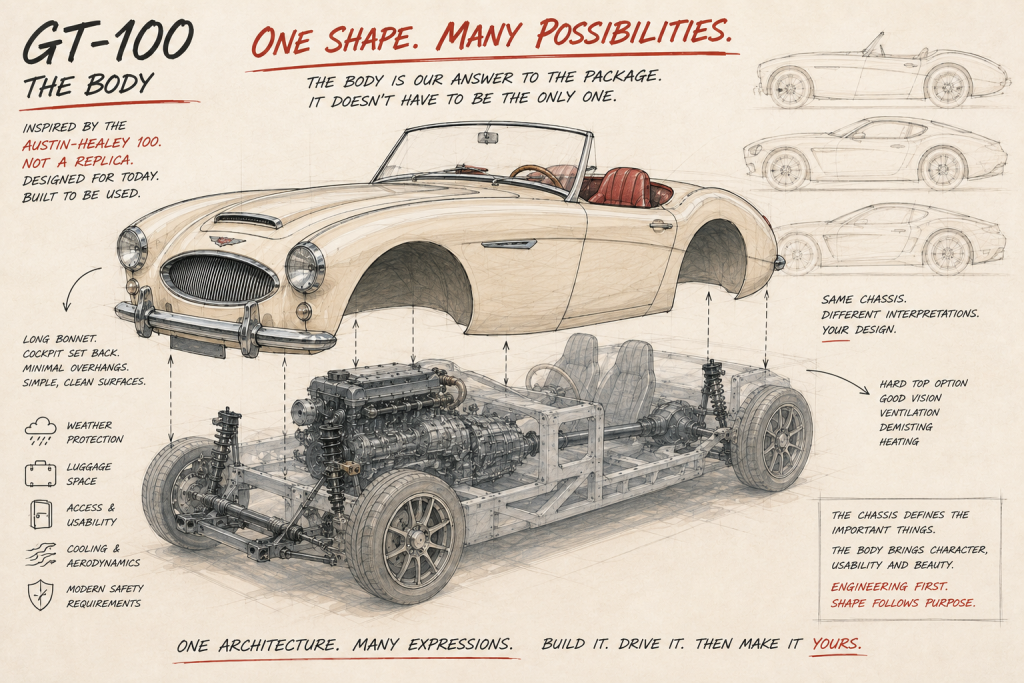
There is no attempt to hide the influence.
The proportions of the GT-100 begin with the Austin-Healey 100: a long bonnet, cockpit set well back in the car, simple surfaces, restrained detailing and relatively little car wrapped around two people.
Seventy years later, it still looks right.
But GT-100 is not intended to be a replica of an Austin-Healey 100.
We are not trying to reproduce every dimension, panel or construction detail of a car designed in the early 1950s.
Instead, the question is:
If we started with those proportions and that philosophy today, where might we end up?
Keep what matters
Part of the appeal of the Healey 100 is its simplicity.
There aren’t many lines.
There aren’t enormous cooling apertures, decorative vents, complicated lighting signatures or surfaces whose primary purpose seems to be giving the styling department something else to draw.
GT-100 should retain that restraint.
The body needs enough detail to make it distinctive, but no more than it needs.
If a line, opening or feature doesn’t have a purpose, there should be a good argument for leaving it off.
Change what needs changing
The original Healey was designed around 1950s people, mechanical components, roads and expectations.
GT-100 isn’t.
The driving position must work for modern occupants.
The doors need to provide sensible access.
There needs to be somewhere for luggage.
The windscreen, mirrors and lighting need to satisfy modern requirements.
The engine needs cooling.
The suspension needs wheel clearance throughout its full range of movement.
The tyres need somewhere to go at full steering lock.
And ideally two people should be able to spend several hours in the car without subsequently requiring assistance to climb out.
Some dimensions will therefore change.
That’s not compromising the design.
That’s designing the car we actually intend to use.
The body should make the car usable
A sports car doesn’t have to be unpleasant simply to prove that it’s sporting.
Weather protection matters.
A properly considered hard top matters.
Ventilation and demisting matter.
Door seals matter.
A heater matters.
So does somewhere to put a weekend bag.
These aren’t luxuries being added to a competition car.
They’re part of the original brief.
The GT-100 should be a car you can choose to take on a journey even when the weather forecast isn’t perfect.
Aerodynamics without changing the character
A shape inspired by a 1950s sports car doesn’t have to have 1950s aerodynamics.
There are opportunities to improve airflow without covering the GT-100 in wings, ducts and appendages.
The front of the car.
Cooling airflow.
The wheel arches.
The floor.
The windscreen.
The hard top.
And particularly the point at which airflow leaves the rear of the car.
Small changes in those areas may produce worthwhile reductions in drag and lift while remaining almost invisible to someone simply looking at the car.
The objective isn’t to make the GT-100 look aerodynamic.
It’s to make it aerodynamic.
[Aerodynamics →]
The body doesn’t define the chassis
This is an important part of the GT-100 idea.
The chassis underneath is intended to establish the things that make the car work:
wheelbase,
track,
suspension geometry,
occupant position,
drivetrain,
controls,
and the principal mechanical hard points.
The body sits around those requirements.
That means our Healey-influenced body is one solution to the GT-100 package.
It doesn’t have to be the only one.
[The Rolling Chassis →]
A body designed to be made
However beautiful a surface may be on a computer screen, eventually somebody has to manufacture it.
That needs to influence the design from the beginning.
Panel splits.
Mould construction.
Surface returns.
Door apertures.
Bonnet and boot openings.
Mounting points.
Access for assembly.
Repairability.
And the number of individual pieces required to make the body.
The manufacturing method has not yet been fixed, and different versions of the car may ultimately justify different materials and processes.
Those decisions should be made because they suit the application, not because one particular material sounds more exotic.
Our body
The first complete GT-100 will establish our interpretation.
A compact two-seat roadster.
Long bonnet.
Low waistline.
Cockpit towards the rear.
Minimal overhangs.
A shape recognisably influenced by the Healey 100 without pretending to be one.
The design will evolve as the engineering underneath becomes more clearly defined.
That’s deliberate.
We shouldn’t finalise the shape of the body and then discover that the engineering doesn’t fit inside it.
The engineering gets to have a vote.
Your body
And then things get more interesting.
Once the rolling chassis and its interfaces are sufficiently well defined, there is no engineering reason why another designer has to reach the same answer that we did.
Keep the wheels where they are.
Keep the occupants where they are.
Respect the mechanical clearances, cooling requirements and regulatory envelope.
Everything else is potentially open to interpretation.
A 1950s-inspired roadster?
A 1960s GT?
Something completely contemporary?
Something we haven’t thought of?
If GT-100 works properly as a rolling chassis, the body becomes an opportunity rather than a restriction.
[Design Your Own Body →]
First, though, we have to build ours
The body you see here isn’t finished.
There will be sketches.
Then surfaces.
Then CAD.
Then aerodynamic work.
Then tooling.
Then panels.
And inevitably there will be things that looked wonderful on a screen and don’t quite work when they’re three-dimensional and sitting in front of us.
That’s development.
As the design becomes real, we’ll show that process rather than quietly replacing yesterday’s drawing with tomorrow’s.
Because watching the shape evolve is part of the project.
[Development →]