Can you build a proper sports car for £20,000?
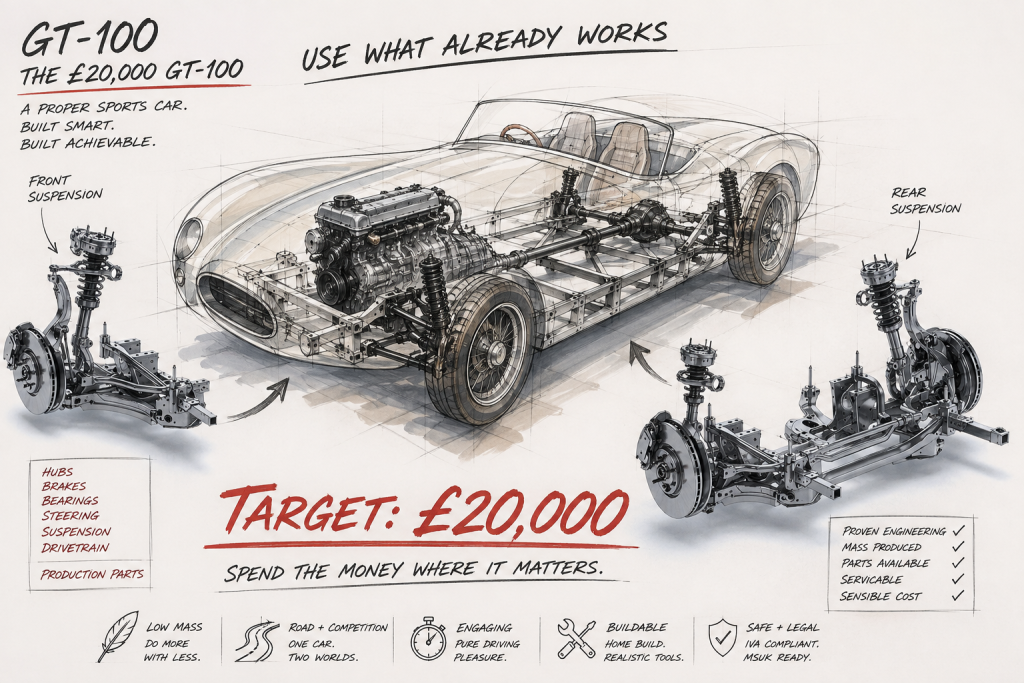
That is the question.
Not a stripped-out track car. Not something assembled from the cheapest components we can find. And not a replica trying to recreate a car designed seventy years ago.
A proper, usable, engaging sports car that you could build yourself, drive to work on Friday, take to a hillclimb on Saturday and drive home again afterwards.
The target is £20,000.
Whether we can actually achieve it is something the development programme will have to prove.
Start with what already exists
Designing and manufacturing every component of a new car from scratch would make a £20,000 GT-100 impossible.
Fortunately, we don’t need to.
Modern production cars contain an extraordinary amount of very good engineering.
Engines, transmissions, differentials, wheel bearings, hubs, brakes, steering components, electrical systems and hundreds of smaller parts have already undergone development, testing and production engineering on a scale that a small-volume manufacturer could never reproduce economically.
The challenge is therefore not:
“How cheaply can we manufacture all these components?”
It is:
“Which components don’t we need to manufacture at all?”
That distinction sits at the heart of the £20,000 GT-100.
One donor. As much as possible.
The initial development is centred around the Jaguar XE X760.
In its four-cylinder form it provides the basis of a remarkably useful component package:
engine, transmission, differential, hubs, bearings, brakes and numerous ancillary components all come from one modern vehicle family.
Using one principal donor has another important advantage.
The components were designed to work together.
Rather than assembling a collection of unrelated parts from half a dozen manufacturers, we can preserve useful relationships between components while designing a much lighter and simpler car around them.
Exactly how much of the donor we ultimately use will be determined during development.
Don’t improve things that don’t need improving
This may be the most important rule of the affordable GT-100.
A beautifully machined billet-aluminium component isn’t automatically better engineering than a £40 production component that has already survived 100,000 miles beneath a Jaguar.
Where a donor component meets the requirement, use it.
Spend development time and money on the things that actually determine what the GT-100 becomes: chassis structure, suspension geometry, packaging, weight distribution and the relationship between the driver and the car.
Lightness changes the equation
The Jaguar XE was designed to carry considerably more mass, equipment and complexity than the GT-100 requires.
That gives us an interesting opportunity.
Components designed for a much heavier production car may have a considerably easier life in a lightweight two-seat sports car.
Brakes don’t need to be enormous simply because enormous brakes look impressive.
Nor does the car need extraordinary power to be quick.
Reducing mass improves acceleration, braking, cornering, tyre loading and potentially fuel consumption simultaneously.
So rather than chasing a horsepower figure, the affordable GT-100 starts with another question:
How much car can we remove?
Simple where simple works
The £20,000 GT-100 should be buildable in a reasonably well-equipped home workshop.
That affects engineering decisions.
Construction methods should not require exotic tooling simply because an exotic solution exists.
Components should be replaceable.
Fasteners should be accessible.
Routine maintenance should not require dismantling half the car.
And where a component can be bought economically from an established supplier, there needs to be a very good reason for us to manufacture another one.
It isn’t the cheap GT-100
There is an important distinction here.
The £20,000 car isn’t intended to be a lesser version of the GT-100.
It is the simplest expression of it.
It should have the same fundamental proportions, suspension philosophy, driving position and character as the more expensive car.
The difference is in how those objectives are achieved.
A production steel component may replace an aluminium one.
A Jaguar brake assembly may replace a motorsport caliper.
A fixed component may replace an adjustable one.
But if an expensive component doesn’t make the car meaningfully better, it doesn’t belong on the £100,000 car either.
What does £20,000 mean?
For now, £20,000 is a design target, not a price list.
The objective is to establish whether a competent builder can construct a complete road-going GT-100 for approximately that amount using a suitable donor and doing a significant proportion of the assembly themselves.
As the design develops, we’ll publish the numbers.
Donor car.
Chassis.
Body.
Suspension.
Brakes.
Wheels and tyres.
Interior.
Electrical system.
IVA.
And all the hundreds of small things that invariably appear between “nearly finished” and actually driving down the road.
If the total isn’t £20,000, we’ll say so.
The constraint is part of the engineering
It would be easy to solve many engineering problems by spending more money.
The interesting problem is finding out how much performance, usability and enjoyment we can achieve without doing that.
That’s why there are two GT-100s.
One asks:
What can we achieve for £20,000?
The other asks:
What can we achieve when we stop worrying about £20,000?