The outside of GT-100 can take inspiration from the great British sports cars of the 1950s.
The inside doesn’t need to inherit their compromises.
A low seating position, simple instruments and an intimate cockpit are part of the character we want to preserve.
Cramped footwells, awkward pedals, poor visibility and a driving position designed around somebody considerably smaller than many of us are not.
So the starting point for the GT-100 interior is simple:
Design the cockpit around the people first.
Not the dashboard.
Not the instruments.
Not the body shape.
The driver and passenger.
Fit the people first
The seating position, pedals, steering wheel and primary controls are fundamental engineering hard points.
They need to be established before the dashboard is styled around them.
That means looking properly at:
- seat height and angle
- legroom
- pedal position
- steering-wheel position
- steering-column angle
- gear selector position
- handbrake
- instrument sightlines
- shoulder room
- headroom
- entry and exit
The objective is not simply to make GT-100 bigger than an original Healey.
It is to make better use of the space we already have.
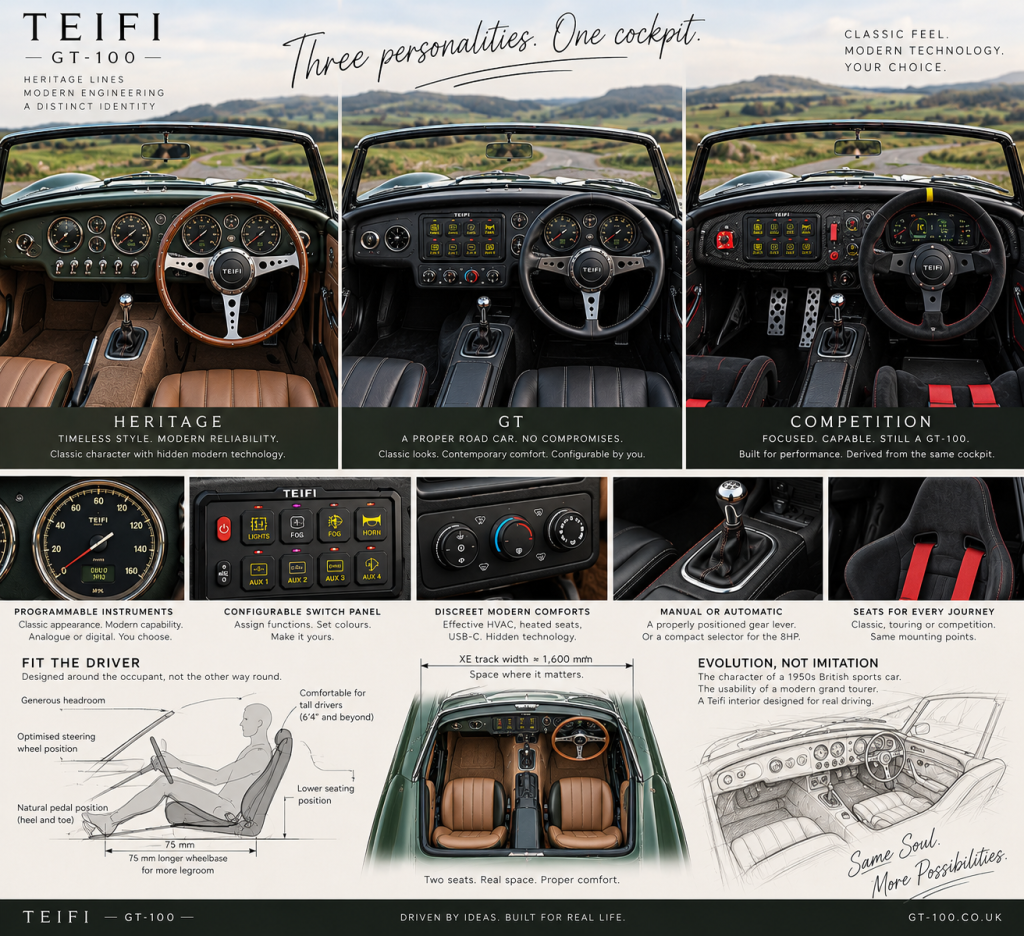
Designed around the occupant, not the other way round.
The relatively wide Jaguar XE architecture may actually help us here.
Keeping approximately the XE track gives the cockpit genuine width for two people, while the low seating position and narrow centre structure should still allow the interior to feel like a sports car rather than a saloon.
Space where it matters.
A proper driving position
The driver should sit in the car rather than on it.
The steering wheel should fall naturally to hand.
The pedals should be placed for comfortable road driving and sensible heel-and-toe operation.
The gear lever — where a manual gearbox is used — should be where your hand expects to find it.
None of those things should be sacrificed merely to make a dashboard look prettier.
We also want to accommodate a much broader range of drivers than many traditional British sports cars manage comfortably.
Exactly what that range becomes will be established properly once the cockpit package is modelled.
For now, the principle matters more than the number:
GT-100 should fit the driver. The driver shouldn’t have to fit GT-100.
One cockpit. Three personalities.
Once the basic ergonomics are right, the character of the interior can change dramatically without changing the car underneath.
That gives us three obvious directions.
Heritage
Timeless style. Modern reliability.
This is the interior closest in spirit to the traditional British sports car.
Simple round instruments.
A clean dashboard.
Toggle switches.
Leather.
Possibly a wood-rim steering wheel.
Very little visual clutter.
But the technology behind it does not need to be from 1956.
Modern electronic instrumentation, engine management, heating, USB power and other useful systems can all be present without dominating the appearance.
The objective is not to recreate an old dashboard.
It is to create the atmosphere of one.
Classic character. Hidden modern technology.
GT
A proper road car. No compromises.
This is probably the natural everyday GT-100 interior.
Still recognisably classic in character, but with more contemporary materials, controls and comfort.
Leather or modern technical fabrics.
Programmable instruments.
Effective heating and ventilation.
Heated seats if wanted.
Modern switchgear where it improves usability.
USB-C and power connections where they are actually useful.
A GT-100 should be a car you can drive for several hundred miles without wishing you had brought another car instead.
Classic looks. Contemporary comfort. Configurable by you.
Competition
Focused. Capable. Still a GT-100.
The competition version strips away what isn’t needed while retaining the same basic cockpit architecture.
Competition seats.
Harnesses.
Appropriate fire-system controls.
Simplified instrumentation.
Clearly identified switches.
Possibly a removable or competition steering wheel.
Materials chosen for function rather than decoration.
But this shouldn’t become an entirely separate car.
The fundamental seating position, control relationship and cockpit structure remain GT-100.
Built for performance. Derived from the same cockpit.
Programmable instruments
Modern electronics give us an opportunity that didn’t exist when the cars inspiring GT-100 were designed.
An instrument can look traditional without being mechanically traditional.
Round programmable displays could give the Heritage or GT interior the appearance of conventional analogue instruments while still providing modern information beneath the surface.
Oil pressure.
Coolant temperature.
Fuel level.
Warning functions.
Navigation information if wanted.
Data from the engine management system.
For a competition car, the same information could be presented much more aggressively.
The underlying data doesn’t change.
Only the way we choose to display it.
Classic appearance. Modern capability.
Configurable switchgear
The same logic applies to switches.
Instead of designing several different wiring looms for several different dashboards, the core electrical system can remain common while the controls presented to the driver change.
A configurable switch panel could allow functions to be assigned according to the car.
Lighting.
Cooling fans.
Fog lights.
Auxiliary functions.
Competition systems.
The Heritage version may disguise more of that technology behind conventional-looking controls.
The GT version might display it openly.
The competition version may put everything immediately to hand.
The important bit is that the underlying electrical architecture does not need reinventing each time.
Modern comforts don’t have to look modern
There are some things modern cars simply do better.
Heating.
Ventilation.
Demisting.
Seat heating.
Electrical power.
Charging devices.
GT-100 doesn’t become less of a sports car because your phone can charge or because you can clear the windscreen on a wet Welsh morning.
The challenge is to incorporate those things without allowing them to dominate the interior.
Keep the technology. Lose the clutter.
A small number of well-designed controls is preferable to an enormous touchscreen controlling functions that should have been switches.
Manual or automatic
The cockpit also needs to accommodate different transmissions.
A manual gearbox requires a properly positioned gear lever and sensible pedal arrangement.
An automatic — particularly something like Jaguar’s ZF 8-speed installation — requires considerably less physical space for the selector.
There is no reason the basic cockpit architecture cannot accommodate both.
The transmission choice changes the controls.
It shouldn’t require a different car.
Status — Design objective
Seats for the journey
The same mounting philosophy could support several types of seat.
A more traditional seat for a Heritage car.
A supportive touring seat for the GT.
A proper competition seat for sprint, hillclimb or track use.
The objective should be to establish common mounting points wherever practical rather than redesigning the structure around every seat option.
Again:
Different personality. Same cockpit.
Spacious, but still a sports car
More room does not mean GT-100 should feel enormous inside.
Quite the opposite.
A good sports-car cockpit should feel close around the driver.
The controls should be within easy reach.
The passenger should feel part of the experience.
The body should still feel visible from the driver’s seat.
What we are trying to remove is unnecessary restriction, not intimacy.
The wider architecture gives us the opportunity for proper shoulder room and usable footwells while still keeping the seats low and close to the centreline of the car.
Two seats.
Real space.
Proper comfort.
No rear seats.
Evolution, not imitation
Just as with the exterior, the interior should not become an exercise in copying an Austin-Healey dashboard.
The Healey provides inspiration.
It does not provide a drawing.
We can keep the things that made those cars special:
Simplicity.
Clear instruments.
Low seating.
A steering wheel directly in front of the driver.
A short route from hand to gear lever.
Materials that feel appropriate in a sports car.
And then add fifty or sixty years of progress where it actually improves the experience.
The character of a 1950s British sports car.
The usability of a modern grand tourer.
That feels like the right target.
What do we need to determine?
The next stage is packaging rather than styling.
We need to establish the actual occupant envelope, seating position, pedal-box dimensions, steering-column route, gear selector position, centre tunnel, shoulder room, sightlines and entry aperture.
Those dimensions then become hard points for the chassis and body.
Which leads to an important point:
The interior does not come after the chassis.
It helps define it.
Put the people in the car first. Then build the structure around them.
Questions still open
How low can the seats realistically sit?
How much fore-and-aft adjustment do we need?
How much steering-column adjustment is worthwhile?
What seat width should we design around?
How large can the footwells be without compromising the chassis or exhaust?
How much luggage space can be retained behind the seats?
How much of the Jaguar HVAC system is useful?
Can the same dash structure support Heritage, GT and Competition interiors?
How much modern technology can be hidden before hiding it becomes more complicated than simply showing it?
We don’t know yet.
That’s what development is for.